Project Description
Washed Robes and Wedding Garments (Revelation 7:14)
Washed Robes and Wedding Garments
How do we do our laundry? Typically, we use clean water and some detergent, or washing powder. We would not attempt to use engine oil, grape juice, or hot chocolate, or blood to get the laundry clean. The use of these liquids would just make a disastrous mess!
Let us turn in our Bibles to Revelation 7:14. This text is a wonderful yet paradoxical text. After one of the twenty-four elders around God’s throne asks John, “Who are these, clothed in white robes, and from where have they come?” John answered, “My Lord, you know.” The elder responded, “These are the ones who have come out of the great tribulation, and they have washed their robes and made them white in the blood of the Lamb.”
Our text is part of the vision of the seven seals, talked about in Revelation chapters 4 to 8, which allows us to look into the heavenly world that describes earthly developments from the first century AD to God’s future finale of glory. Revelation 7 answers the question of who will be able to stand at Christ’s Second Coming.
Revelation 7:9-17 looks at the time after the Second Coming of Jesus. The people of God have come out of the great tribulation and now worship and serve God in the heavenly sanctuary, experiencing peace, satisfaction, comfort, and joy. Wearing the robes of conquerors, they praise God the Father and Jesus Christ for their redemption.
But how did salvation come about?
Those who are saved have washed their robes in blood. The detergent is the blood of the Lamb.
According to Scripture, clothes got dirty by skin diseases. Let us look at Leviticus 13:6. Clothes also got dirty by the handling of carcasses. Let us look at Leviticus 11:25.
Salvation through death! It also implies that we cannot save ourselves but depend on the merits of Jesus to stand before God in the spotless robes of Christ’s righteousness, not our own robes.
While Revelation 1:5 emphasizes Jesus’ initiative, Revelation 7:14 indicates that it is also our responsibility to wash our clothes. However, neither can we save ourselves and make ourselves stand before God’s throne, nor can we contribute to our salvation. It is still Jesus who saves, independent of human works. But we must accept the divine gift.
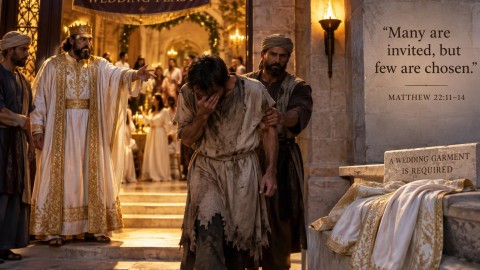
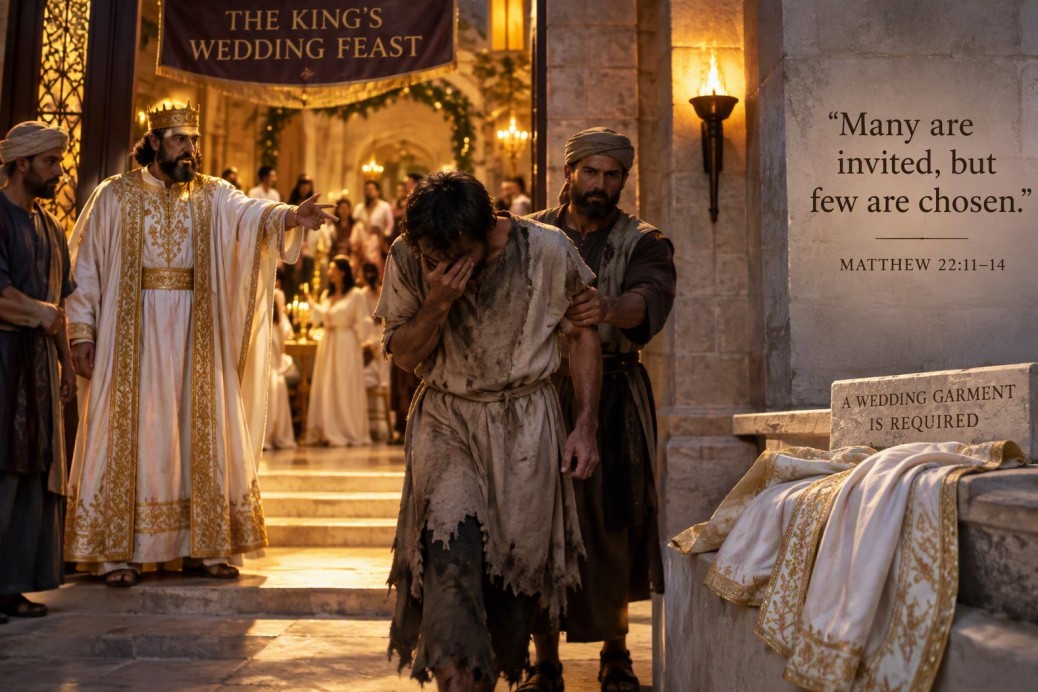
Let us look at the parable of the wedding garment in Matthew 22:11-13.
When the king came in to view the guests, the real character of all was revealed, for every guest at the feast had been provided a wedding garment. This garment was a gift from the king. By wearing it, the guests showed their respect for the giver of the feast. But one man was clothed in his common citizen dress. He had refused to make the preparation required by the king. The garment provided for him at great cost he disdained to wear. So he insulted his lord.
To the king’s demand, “How did you come in here not having a wedding garment?” he could answer nothing. He was self-condemned.
The wedding garment in the parable is represented by the pure, spotless character which Christ’s true followers will possess. In Revelation 22:12 the church is given that she should be arrayed in fine linen, clean and white, not having spot or wrinkle, or any such thing. The fine linen, says the Scripture, “is the righteousness of the saints,” which is the righteousness of Christ, His own unblemished character, that through faith is imparted to all who receive Him as their personal Saviour.
Only the covering which Christ Himself has provided can make us fit to appear in God’s presence. This covering, the robe of His own righteousness, Christ will place upon every repentant, believing soul. This robe, woven in the loom of heaven, has in it not one thread of human devising. Christ, in His humanity, wrought out a perfect character, and this character He offers to impart to us.
The man who came to the feast without a wedding garment represents the condition of many in our world today. They profess to be Christians and lay claim to the blessings and privileges of the gospel, yet they feel no need of a transformation of character. They have never felt true repentance for sin. They do not realize their need of Christ or exercise faith in Him. They have not overcome their hereditary or cultivated tendencies to wrongdoing.
Yet they think that they are good enough in themselves, and they rest upon their own merits instead of trusting in Christ. Hearers of the word, they come to the banquet, but they have not put on the robe of Christ’s righteousness.
Those whose robes are washed belong to God and participate in Jesus’ victory, having been separated from sin and Satan. They have prayed the prayer of David. Let us look at Psalm 51:1-3. They also rely on the divine
promises in Isaiah 1:18. Let us look at it. Salvation is a paradox and a miracle in many ways.
A parallel text is found in Revelation 22:14: “Blessed are those who wash their robes, so that they may have the right to the tree of life and that they may enter the city by the gates.”
The symbol of washing their robes in the blood of the Lamb will have tremendously positive results.
However, there is one important difference between Revelation 7:14 and Revelation 22:14. In Revelation 7:14 the meaning is a once-for-all washing: “They washed their robes.” According to Revelation 22:14, believers are washing their robes, which refers to repeated washing. Both aspects are important.
There is an initial and basic washing of our robes, quite likely associated with baptism. Jesus provides those who ask Him with His merits, forgiveness, and eternal life.
There is also the continual washing of our robes. Those who have experienced Jesus’ marvelous gift will follow Him in love and obedience. They allow His character to be developed in them, repenting of their sins that still may occur and renewing their covenant with Him by daily committing their lives to Him. Thus, the Spirit will show them their sins.
So, in summary, the washing in Jesus’ blood points to justification and sanctification, our faith in Christ and our faithfulness to Him, our assurance through Him, and our witness for Him.
The three key points that we can draw from Revelation 7:14 are:
Firstly – The issue of the paradox of salvation.
Why does God speak in such a paradox? It is because paradoxes capture attention and help us remember.
This specific paradox was foreshadowed by the Old Testament sacrificial system, in which an innocent creature died for a guilty person to provide forgiveness. Furthermore, washing dirty clothes in Jesus’ blood is intended to show us that what is impossible for human beings is possible through God.
Secondly – It is all about Jesus.
The text focuses on Jesus more than on believers. Only He can save.
Even the clothes of those involved in the sacrificing of animals needed to be washed. Let us read Leviticus 16:26-28.
When the people of Israel were at Mount Sinai, they needed to wash their clothes before their divine encounter. Let us look at Exodus 19:10.
In the Old Testament such clothes were real garments. In Revelation, they are symbolic robes. Revelation 7:14 assumes that we are sinners, needing cleansing and liberation from sin.
Making clothes white describes the same process as washing does. But the whitening highlights not only the concept of purity but also victory.
No wonder that the people of God walk with Jesus dressed in white. Let us look at Revelation 3:4-5. The martyrs are given white robes as well. Let us look at Revelation 6:11.
Then the great multitude of Revelation 19 have also been given pure white linen to wear. Let us read Revelation 19:6-8.
But how can blood be used as a cleansing agent, and how can a lamb be a shepherd, as Revelation 7:17 says? It is a paradox.
The dictionary definition of the word paradox is a statement that seems self-contradictory or absurd but, in reality, expresses a possible truth.
True believers are already saved here but are not yet fully saved. The paradox here describes salvation as an ongoing victory.
Revelation 1:5 states that Jesus has freed us from our sins by His blood. Because Hebrews 9:22 tells us that “without the shedding of blood there is no forgiveness,” the divine Lord became a human being and died on the cross to provide forgiveness.
Let us look at John 1:7.
So, because of Calvary, we have freedom from the enslavement of sin and the gift of eternal life.
“…and transform us.
Thirdly,
the text calls for a decision. Will we wash our robes and make them white in the blood of the Lamb? Will we continue to wash them to maintain eternal life in the presence of God?
So do not forget: what is impossible with us is possible with God, our salvation. It is all about Jesus, who died for us to grant us everlasting life.
It is also about our decision for Jesus and our life with Him.
Washed Robes and Wedding Garments
Claire Manser
Ceremon Auckland New Zealand
-
Wedding Garments
Project Description Washed Robes and Wedding Garments (Revelation 7:14) Washed Robes and Wedding Garments How do we do our...
-
Lenchik Smile
Project Description Lenchik Smile From DentoraShort Trip - Teaser about our trip to Wellington and Rurapehu Mountan Linchik Slime...
-
Short Trip – Teaser
Project Description Short Trip - TeaserShort Trip - Teaser about our trip to Wellington and Rurapehu Mountan Short Trip...
-
Trip To Wellington
Project Description Trip To WellingtonTrip To Wellington and Rurapehu Mountan Trip To Wellington Trip To Wellington and Rurapehu Mountan,...
-
-
Mobile Cuts 2
Project Description Mobile Cuts 2Mobile Cuts 2 Mobile Cuts 2 Mobile cuts videos, filmed in difrent times and diffrent...